 roundup
 Kimi K3, Thinking Machines' Inkling, and the enterprise trust gap
Kimi K3's 2.8T-param open model challenges frontier labs, Mira Murati ships Inkling, and three enterprise surveys reveal agents failing in production.
The big picture
Two genuinely large open-weight model releases landed today — Moonshot’s Kimi K3 and Mira Murati’s Thinking Machines Inkling — at a moment when three separate enterprise surveys are painting an uncomfortable picture: companies are handing AI agents real autonomy over real systems while their evaluation, security, and cost-visibility infrastructure is nowhere close to ready. The hardware gimmicks (OpenAI’s basketball, a joystick controller) are easy to dismiss; the structural gaps in enterprise AI deployment are not.
Kimi K3 and Inkling: the open-weight frontier just moved
Moonshot AI’s Kimi K3 is the headline model drop of the day, and it’s a legitimate one. At 2.8 trillion total parameters — the lab calls it a “3T-class model” — it’s the largest open-weight model released by any Chinese AI lab, more than doubling DeepSeek V4 Pro’s 1.6T count. It’s currently available via API and the Kimi website, with full weights promised by July 27. Benchmark-wise, Moonshot’s self-reported numbers put K3 ahead of Claude Opus 4.8 and GPT-5.5 High, trailing only Claude Fable 5 and GPT-5.6 Sol. Artificial Analysis gives it an Elo of 1547 on long-horizon knowledge work, a jump of 732 points over K2.6, and it’s already sitting at the top of Arena.ai’s Frontend Code leaderboard above even Fable 5. That last data point is the one worth watching for developers — if you’re building UI generation tooling, K3 is worth a benchmark run right now. The pricing signals a deliberate repositioning: $3/M input and $15/M output tokens, matching Claude Sonnet tier and making it the most expensive Chinese AI model to date. The era of aggressively underpriced Chinese AI is clearly winding down. Simon Willison | The Decoder | TechCrunch
The other open-weight story is Thinking Machines Lab — the startup founded by former OpenAI CTO Mira Murati — shipping its first model, Inkling. It’s a Mixture-of-Experts architecture (MoE means only a subset of the model activates per token, so it’s cheaper to run than a dense model of equivalent total size) with 975B total parameters and 41B active, trained on 45 trillion tokens of text, images, audio, and video. License is Apache 2.0, which is as permissive as it gets. Crucially, the lab is honest that this isn’t a frontier model — they’re positioning it explicitly as a strong base for fine-tuning via their Tinker platform. A smaller Inkling-Small (276B total / 12B active) is still being tested. Simon Willison flags that the model card and training data documentation are unusually thin, with vague language about “publicly available content” and “third-party datasets” that offers almost no transparency. Worth noting for anyone doing due diligence before fine-tuning on top of it. Apache-2.0 multimodal MoE with fine-tuning infrastructure attached is a genuinely useful package — just go in with eyes open on the provenance question. Simon Willison
The enterprise agent gap — three surveys, one ugly pattern
VentureBeat published three separate survey-based research pieces today, and the pattern across all three is striking enough that they’re worth reading together rather than in isolation.
On context and retrieval: across 101 enterprises, 57% reported their AI agents produced confident but wrong answers traceable to missing or inconsistent business context — and more than half of those said it happened multiple times. RAG (retrieval-augmented generation — feeding agents live business data instead of relying purely on their training) is already the primary context source for 38% of respondents, more than any other approach. Provider-native retrieval (OpenAI file search, etc.) has quietly overtaken purpose-built vector databases in practice, even as organizations say they intend to keep best-of-breed tooling. The fix most are converging on is a governed semantic layer — basically a trusted, versioned definition of what business terms and data mean — but only a minority have it in production. VentureBeat
On evaluation: across 157 enterprises, half have shipped an agent that passed internal evals and then failed a customer in production. Only 5% fully trust automated evaluation. The single most-cited weakness is that evals don’t reflect real-world outcomes. Despite that, two-thirds are already allowing or actively moving toward fully automated, zero-human-in-the-loop deployment. The gap between eval trust and deployment autonomy is not a small one — it’s a structural bet that production failures are cheaper than slower release cycles, and for most teams that bet hasn’t been tested yet. VentureBeat
On security: across 107 enterprises, 54% have already had a confirmed agent security incident or near-miss. Only 32% give every agent its own scoped identity — the rest are running agents on shared credentials or shared API keys. Only 30% sandbox their highest-risk agents. The security tooling is overwhelmingly borrowed from model providers and hyperscalers rather than purpose-built for agent workloads. If you’re building agentic systems and you’re not assigning per-agent identities with scoped permissions, you’re one misconfigured tool call away from a wide blast radius. VentureBeat
A fourth survey, on compute, rounds out the picture: 83% of enterprises report GPU utilization of 50% or less, fewer than 44% can rigorously track their AI compute costs, yet 64% plan to switch or add infrastructure providers within the year. Buying fast, seeing poorly. VentureBeat
Regulation and policy: Germany acts, the EU pushes, New York legislates with AI
Germany’s media regulators issued what appears to be the first ruling of its kind globally: Google’s AI Overviews and Perplexity are now classified as the companies’ own editorial content under the German State Media Treaty, not neutral search results. The practical implication is that AI-generated summaries that crowd out publisher links carry legal accountability as media content. Both companies have a month to appeal. This is a meaningful precedent — it’s the first time a national regulator has formally categorized AI answer surfaces as publisher content rather than index infrastructure, and the legal logic could travel. The Decoder
The EU, separately, finalized requirements forcing Google to share search data with competitors and open up AI distribution on Android. Google’s stated concern is user privacy and security, which is the argument every gatekeeper makes when compelled to share access. The longer-term effect on third-party search and AI assistant distribution on Android is worth watching. Ars Technica
New York Governor Kathy Hochul mentioned in a Bloomberg interview that her team is running AI over the state’s complete body of rules and regulations to surface outdated legislation — laws like a $25 fee to take a dog hunting or midnight-work permits for pregnant people. She estimated manual review would have taken five years at staff level. This is a practical, low-stakes use of AI that actually makes sense. The Verge
And xAI filed its first lawsuit against a Grok user over generated CSAM, after previously being unable to deny the capability existed. The lawsuit itself is not a safety strategy. Ars Technica
Google’s product week: NotebookLM gets a rebrand, Search gets app hooks
Google is renaming NotebookLM to Gemini Notebook — which is either a sensible ecosystem consolidation or a warning sign that a beloved product is about to get absorbed into Gemini’s brand gravity, depending on your trust level. More substantively, each notebook now gets its own cloud compute environment that can write and run code, available first to AI Ultra and Workspace subscribers. That’s a real feature addition, not just a rename. The original NotebookLM launched as Project Tailwind in May 2023 and has accumulated a strong following for its AI podcast generation and document synthesis; whether the Gemini branding helps or hurts user perception will be an interesting split test for Google’s product org. The Decoder | The Verge
Google’s AI Mode in Search is also getting app integration — you can now connect third-party apps and have Search complete tasks across them, not just answer questions. This overlaps directly with what Google is doing with the Gemini assistant and what Apple Intelligence is trying to do with Siri, and it puts Search back in the agentic action race. Separately, Google Vids is adding personalized AI avatars so you can generate videos starring a digital version of yourself, powered by Gemini Omni. Corporate training video market, consider yourself targeted. TechCrunch (AI Mode) | TechCrunch (Vids)
Agents get physical: DoorDash CLI, OpenAI’s joystick, and a Codex file-deletion bug
DoorDash is launching a limited beta of dd-cli, a command-line tool that lets developers and AI agents search stores, build carts, and place real orders from a terminal. The actual target here isn’t humans who prefer typing over tapping — it’s AI agents that need structured, programmatic access to real-world commerce without scraping a web UI. This is what agent-native API design looks like in practice, and it’s a useful signal that consumer platforms are starting to build surfaces designed for machine consumption, not just human convenience. TechCrunch
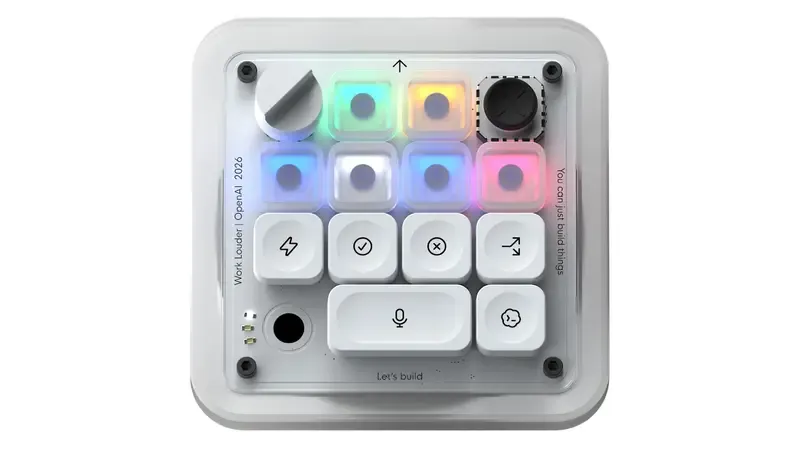
OpenAI and keyboard maker Work Louder unveiled the Codex Micro, a compact hardware controller with a joystick designed for managing AI agents. The pitch is that joystick-and-dial physical controls are more ergonomic for agent supervision than typing commands. It’s an interesting hypothesis, and Work Louder makes genuinely nice hardware, but the market for a dedicated AI agent controller seems narrow today. File under: early-adopter curiosity, revisit in 18 months. The Decoder
Meanwhile, a real and gnarly issue: OpenAI’s GPT-5.6 / Codex has a confirmed bug where, in full-access mode without sandboxing, the model can accidentally delete a user’s home directory. The failure chain is specific — the model tries to override the $HOME environment variable to create a temp directory, makes an honest mistake, and deletes $HOME itself. OpenAI engineer Thibault Sottiaux confirmed the finding publicly. The fix is to run Codex with sandboxing and auto-review enabled, which you should be doing anyway. But this is a good reminder: coding agents with filesystem access need tight guardrails, and “honest mistake” is not a reassuring phrase when the mistake is rm -rf $HOME. Simon Willison
Linus Torvalds, Hyundai robots, and the open-source AI stack
Linus Torvalds responded to calls for banning AI coding tools from Linux kernel contributions with characteristic directness: fork it or walk away. He said he will “very loudly ignore” any campaign for an AI ban. This doesn’t resolve any of the real questions around AI-generated code quality, license provenance, or contributor accountability in open-source projects — but it does settle who sets the tone for the Linux kernel specifically. Ars Technica
Hyundai workers at a factory are striking over the company’s plan to deploy 25,000 Atlas humanoid robots starting in US factories in 2028. The fear of displacement is shaping labor action before the robots have even arrived — which is a meaningful escalation from abstract concern to concrete collective bargaining. Ars Technica
Sakana AI is integrating Nvidia’s Nemotron open models into its Fugu multi-model orchestrator (Fugu dynamically routes tasks across multiple LLMs rather than sending everything to one model). The claim is that coordinated open models can rival frontier closed systems. The announcement doesn’t include benchmark figures for the new combination yet, so treat it as a directional signal rather than a proven result. Separately, Nvidia’s Nemotron 3 Embed is now ranked first overall on the RTEB retrieval benchmark, which is relevant if you’re building agentic retrieval pipelines and want an open embedding model. The Decoder (Sakana) | Hugging Face (Nemotron Embed)
Andrew Dai, a former DeepMind researcher whose work informed ChatGPT’s development, raised at a $300M pre-seed valuation before shipping a product, betting on visual AI as the next frontier. That valuation is extraordinary for pre-product, even in the current climate — but the pedigree and the thesis are both legible. AMI Labs CEO Alexandre LeBrun, who runs Yann LeCun’s world model startup, is publicly refusing to use the words “AGI” or “superintelligence” to describe his work, which is a notable stance when every other lab is racing to claim those terms. TechCrunch (Dai) | TechCrunch (LeBrun)
Quick hits
- Energy company IPOs are raising money at the fastest pace this century, with investors treating power infrastructure as a proxy bet on AI compute demand. Ars Technica
- OpenAI published a case study on Cars24, which uses OpenAI-powered voice and chat agents to handle over 1 million monthly conversation minutes and reportedly recovered 12% of otherwise lost leads. OpenAI
- OpenAI published its teen safety policy rationale, covering age-appropriate protections, parental controls, and content guardrails for ChatGPT. Thin on technical specifics, heavy on framing. OpenAI
- Roblox launched a “Build” feature in its mobile app that generates a basic game from a single text prompt, targeting a younger mobile creator audience. TechCrunch
- OpenAI is selling a ChatGPT-branded basketball alongside its first hardware release. No further analysis warranted. TechCrunch
Sources
- TechCrunch — DoorDash CLI
- TechCrunch — OpenAI basketball
- The Decoder — OpenAI Codex Micro joystick
- TechCrunch — Andrew Dai / $300M pre-seed
- TechCrunch — AMI Labs / Alexandre LeBrun
- TechCrunch — Kimi K3 / Moonshot
- The Decoder — Kimi K3 benchmarks and pricing
- Simon Willison — Kimi K3
- The Decoder — Sakana AI / Nemotron
- Simon Willison — Thinking Machines Inkling
- TechCrunch — Google AI Mode app integration
- VentureBeat — Enterprise RAG / context gap
- VentureBeat — Agent evaluation gap
- Ars Technica — Energy IPOs
- The Decoder — Germany media law ruling
- Hugging Face — Nvidia Nemotron 3 Embed
- OpenAI — Teen safety
- OpenAI — Cars24 case study
- TechCrunch — Google Vids avatars
- The Decoder — NotebookLM → Gemini Notebook
- The Verge — Gemini Notebook rename
- TechCrunch — Roblox Build feature
- VentureBeat — Agent security gap
- The Verge — New York Governor AI regulation review
- Simon Willison — Codex GPT-5.6 file deletion bug
- VentureBeat — Enterprise compute gap
- Ars Technica — EU forces Google search data sharing
- Ars Technica — xAI / Grok CSAM lawsuit
- Ars Technica — Hyundai Atlas robots strike
- Ars Technica — Linus Torvalds on AI coding