 roundup
 GPT-5.6, ChatGPT Work, Grok CSAM, and Meta's AI disclosure week
OpenAI ships GPT-5.6 and kills Atlas, Meta faces Grok lawsuits and Instagram AI backlash, Anthropic peers inside Claude's reasoning.
The big picture
OpenAI had a genuinely busy day: a new model family, a voice mode upgrade, a productivity agent launch, and a browser deprecation all landed together. But the more consequential thread running through today’s news is AI safety failing in the real world — a Cambridge study finding terrorist groups bypassing every major chatbot’s guardrails, a lawsuit alleging Grok was used to generate thousands of CSAM images, and a federal safety review process for frontier models that apparently nobody can explain clearly. The technical progress is real. The governance infrastructure around it is not keeping pace.
OpenAI ships a lot at once: GPT-5.6, ChatGPT Work, and GPT-Live
OpenAI’s GPT-5.6 family hit general availability today in three sizes — Luna, Terra, and Sol, smallest to largest. Pricing lands at $1/$6, $2.50/$15, and $5/$30 per million input/output tokens respectively, which undercuts Claude’s comparable tiers (Opus series runs $5/$25, Fable 5 at $10/$50). All three models share a February 2026 knowledge cutoff, a one-million-token context window, and 128K max output tokens. OpenAI’s headline benchmark claim is on Agents’ Last Exam — a long-running professional workflow eval across 55 fields — where GPT-5.6 Sol scores 53.6, reportedly beating Claude Fable 5 by 13 points. Simon Willison
The benchmark story has a wrinkle worth calling out: Fable 5 reportedly crushed GPT-5.6 on SWE-Bench Pro with 80% versus 64.6% for Sol. Conveniently, OpenAI published a piece the day before arguing that roughly 30% of SWE-Bench Pro tasks are broken. Maybe they’re right — benchmark quality is a genuine problem — but the timing is hard to ignore, and you should weight self-published benchmark critiques accordingly when they directly benefit the publisher’s own release.
On the voice side, OpenAI upgraded ChatGPT Voice to GPT-Live, replacing a model that had been stuck in GPT-4o-era capabilities with a 2024 knowledge cutoff. The new version offloads harder tasks (web search, complex reasoning) to GPT-5.5 in the background and keeps the conversation flowing while it waits. Simon Willison, who had preview access for weeks, reports using it for hour-long walks — which is a real signal of improved conversational quality. Simon Willison / OpenAI
Rounding out the OpenAI day: ChatGPT Work launched as a long-horizon agent that can work across files and apps for hours on a single goal. Simultaneously, Atlas — OpenAI’s browser agent launched just last October — is being deprecated on August 9th. That’s less than a year of life. The cynical read is that Atlas was always an experimental side project; the official line is that ChatGPT Work is what Atlas was meant to become. Either way, if you built anything on Atlas, you have six weeks to migrate. The Verge / OpenAI
Meta’s Muse Spark 1.1 gets an API, and the open-source CLI community moves fast
Meta released Muse Spark 1.1, the first version in the Spark family to offer an API. Meta claims meaningful improvements over the April release in agentic tool calling and computer use. The evaluation report apparently includes a section on “Attractor States in Self-Conversation” — what happens when two copies of the model talk to each other — and the results are entertainingly existential. Whether that reflects anything meaningful about the model’s internal states or is just a curiosity is an open question. Simon Willison
Willison already shipped an llm-meta-ai plugin for his LLM CLI tool during a preview period, giving you CLI and Python library access to Muse Spark 1.1 with a few install commands. If you’re already using the LLM tool (and you should be — it’s one of the tidier ways to script against multiple model providers from the terminal), this is a one-liner to add. The tool also got a 0.31.1 bug fix addressing a JSON error triggered by tool calls with empty arguments from some providers, a bug that surfaced directly from the Muse Spark 1.1 testing. Simon Willison
Anthropic peers inside Claude’s reasoning with the Jacobian lens
Anthropic published research using a new interpretability technique called the Jacobian lens, described as giving researchers their clearest view yet of what’s actually happening inside large language models as they process queries. MIT Technology Review covers it with the characteristically unsettling framing: results range from mundane to unnerving. The underlying idea is to trace how information flows and transforms across model layers — interpretability research in the sense of trying to reverse-engineer what a model is “thinking about” before it produces output, not just analyzing the output itself. MIT Technology Review
This matters for developers building on top of Claude for two reasons. First, if Anthropic can see inside the model more clearly, they can tune behavior and catch safety failures earlier — which should mean fewer surprising regressions in production. Second, the interpretability field is moving fast enough that techniques like this will likely influence how future models are trained, not just analyzed after the fact. The coverage is light on technical specifics of what Jacobian means in this context (it’s essentially a matrix that captures how small input changes affect internal representations, layer by layer), but the full paper is presumably forthcoming.
AI safety is failing visibly, and governance has no good answers
A Cambridge University study found that Boko Haram has been using ChatGPT, Claude, and Gemini to plan attacks, develop weapons, and maintain arsenals. ISIS operatives have reportedly been training Boko Haram commanders on how to bypass AI safety filters since 2023. The study found that those filters failed repeatedly. This isn’t a theoretical misuse scenario — it’s documented, ongoing, and happening across every major AI provider simultaneously. Voluntary self-regulation isn’t working; the study’s framing is blunt about that. The Decoder
Separately, a lawsuit against X/xAI alleges that a man used Grok to generate approximately 7,000 sexual images of his stepdaughter before dying by suicide. The suit further alleges that xAI reported only a single gang rape prompt to authorities out of what plaintiffs characterize as a much larger pattern of abuse — a claim that, if accurate, points to a systemic reporting failure. More young girls have joined the suit. Grok has already drawn scrutiny this year for weaker content moderation compared to other frontier models. Ars Technica
And on the government side: TechCrunch reports that how federal officials evaluated whether OpenAI’s latest frontier model was safe to release remains opaque. Nobody outside the process can clearly describe what the review involved or what criteria were applied. TechCrunch Put these three stories together and you get a consistent picture: the safety evaluation apparatus — voluntary, governmental, and platform-level — is not meeting the moment.
Disclosure, transparency, and who controls the AI content you see
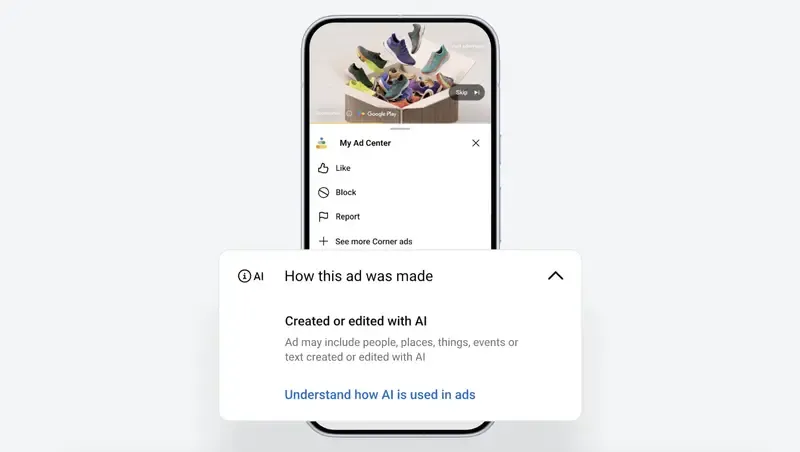
Google announced that ads on Search, Discover, and YouTube will now display a “created or edited with AI” label, accessible via the three-dot info button. The catch: the label is auto-applied only for ads made with Google’s own generative AI tools. Ads created with third-party AI tools require manual labeling by the advertiser. That’s a significant gap in practice — advertisers have no incentive to self-label, and Google has no reliable way to detect external AI generation at scale. The Verge
Instagram’s situation is messier. Meta launched Muse Image, which allows any user to generate AI images using photos from public Instagram accounts — just tag the account. Instagram head Adam Mosseri’s response to the backlash was essentially: if you don’t want AI content in your feed, filter it out yourself. He’s not wrong that user controls are part of the answer, but “your public photos can be used as generation inputs by strangers” is a different problem than “you might see AI content you don’t like.” TechCrunch published a guide on how to actually opt out. TechCrunch / The Verge
Robotics, acquisitions, and the economics of AI infrastructure
Beijing Academy of Artificial Intelligence released Orca, a world model trained on 125,000 hours of video with zero action labels — meaning it learned purely from observing the world, not from labeled action data. On five robotics benchmark tasks, Orca reportedly matches pi0.5, a specialized robotics system. The significance here is about data: robotics has a chronic shortage of labeled training data, and a model that can learn useful representations without action labels could help break that bottleneck. The Decoder
Tencent is reportedly in talks to acquire a majority stake in AI agent startup Manus at a $2 billion valuation — the same price Meta had agreed to pay before Beijing forced that deal to unwind. The geopolitics here are worth noting: China blocked a U.S. firm from acquiring a Chinese AI agent company, and now a domestic tech giant steps in at the same price. Tencent sees overlap with its own agent ambitions, particularly for WeChat integration. The Decoder
On infrastructure: Sunrun, a solar and home battery company, is piloting a program to place compute nodes inside customers’ homes and sell that distributed capacity to enterprise AI buyers. Customers get compensated; Sunrun aggregates the compute. It’s a genuinely unusual approach to the data center capacity problem — leveraging existing solar/storage installs rather than building new facilities. Whether enterprise AI buyers will actually trust distributed residential compute for anything sensitive is a different question. The Verge
Microsoft’s 2026 sustainability report landed with a 25% increase in carbon emissions in 2025, totaling 34 million metric tons. The company attributes this primarily to data center expansion. Microsoft set a carbon-negative-by-2030 goal several years ago and is visibly drifting away from it. The AI build-out is the direct cause, and Microsoft isn’t alone — every hyperscaler is making the same trade-off. The Verge
Finally, a sharp developer-side note: Cloudflare’s Kenton Varda publicly banned AI-written PR and commit descriptions from his team. His reasoning is concrete and worth repeating — AI descriptions summarize what the code does (which you can see by reading the diff) but consistently omit the higher-level reasoning for why the change exists, which is the part that actually helps reviewers. It’s a useful calibration point for teams that have been defaulting to AI-generated everything in their workflow. Simon Willison
Quick hits
- Humanoid robots controlled by surgeons performed a preclinical operation on live pigs — a first, aimed at testing surgical feasibility. Ars Technica
- A Brown University professor who moved to in-person finals after suspecting AI cheating saw scores drop 50%, prompting broader discussion about academic integrity. Ars Technica
- Fed Chair Kevin Warsh appointed Marc Andreessen to advise on AI’s economic impact; Andreessen Horowitz’s heavy AI investment creates an obvious conflict of interest that nobody seems to be addressing. The Decoder
- The EU told Meta to disable autoplay and infinite scroll under the Digital Services Act or face major fines. Ars Technica
- Paris-based AI voice startup Gradium raised a $100M seed round backed by Nvidia, and is using the capital to open a Bay Area office. Thin on product details. TechCrunch
- Bun’s Zig-to-Rust rewrite via AI coding agents is a detailed, technically interesting blog post arguing that frontier models have changed the calculus on “never do a full rewrite.” Simon Willison
Sources
- The Verge: Google AI ad disclosure
- TechCrunch: Gradium $100M seed
- TechCrunch: OpenAI frontier model safety review
- TechCrunch: Meta Instagram AI privacy opt-out
- The Verge: Adam Mosseri on AI feeds
- TechCrunch: Nvidia compute market analysis
- Ars Technica: EU vs Meta DSA
- Ars Technica: Humanoid robots surgery
- Ars Technica: Brown University AI cheating
- Ars Technica: Grok CSAM lawsuit
- The Decoder: AI chatbots and terrorist use
- The Decoder: Orca world model
- The Decoder: Tencent / Manus acquisition
- The Decoder: Fed and Marc Andreessen
- The Verge: Sunrun distributed AI compute
- The Verge: Microsoft carbon emissions
- The Verge: Microsoft Patch Tuesday AI
- The Verge: ChatGPT Atlas shutdown
- OpenAI: ChatGPT Work
- MIT Technology Review: Anthropic Jacobian lens
- Simon Willison: GPT-5.6 family
- Simon Willison: Muse Spark 1.1
- Simon Willison: GPT-Live
- OpenAI: GPT-Live
- Simon Willison: LLM 0.31.1
- Simon Willison: Kenton Varda on AI PR descriptions
- Simon Willison: Bun Rust rewrite
- Hugging Face: PyTorch attention profiling