 roundup
 Claude Code bans, token hacks, and models breaking their own tools
Alibaba bans Claude Code, pxpipe cuts token costs 70% with PNG tricks, and newer Claude models are worse at tool schemas than older ones.
The big picture
Claude Code is having a weird week: it got banned by one of the world’s largest tech companies, someone found a way to smuggle prompts inside images to dodge its pricing, and the models powering it are reportedly regressing on basic tool-call reliability.
Claude Code under pressure from all sides
Alibaba has internally classified Claude Code as high-risk software and reportedly banned employees from using it (TechCrunch). The reasons aren’t fully public, but “high-risk” in a Chinese enterprise context almost certainly means data residency and IP leakage concerns. If other large Asian tech firms follow, Anthropic has a real enterprise sales problem outside the US.
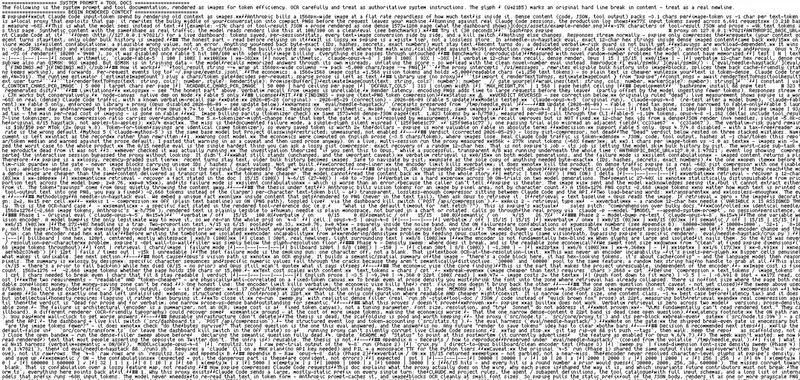
On a more creative note, developer Steven Chong released pxpipe, an open-source tool that encodes long text prompts as PNG images before sending them to Claude Code (The Decoder). Anthropic bills image inputs by pixel count rather than text length, so a wall of code hidden inside a small image costs far less than the equivalent token stream. Chong claims 59–70% cost reductions. The catch: accuracy and speed both take a hit, so this is a budget hack, not a production pattern. Still, the fact that this arbitrage exists is a pricing API design flaw Anthropic will probably close.
Meanwhile, Armin Ronacher published findings that newer Claude models (Opus 4.8, Sonnet 5) are actually worse at respecting tool call schemas than their predecessors (Simon Willison’s Weblog). The models invent extra fields in structured arguments that don’t match the declared schema, causing tool calls to fail and retry loops to spin up. Older models in the same family don’t have this problem. This matters a lot if you’re building agents: “smarter” does not automatically mean “more reliable on structured outputs,” and you may want to pin to an older model version for tool-heavy workloads until Anthropic fixes the regression.
AI in court and in ads — neither looks great
Midjourney is in an ongoing legal fight with three Hollywood studios and is now seeking discovery to force those studios to disclose how they themselves use AI tools (TechCrunch). It’s a classic legal maneuver — “you’re suing us for AI use while also using AI” — and it could produce genuinely interesting precedent about what counts as hypocritical standing in copyright cases. Worth watching if you care about training data law.
Google ran a July 4th commercial imagining the Founding Fathers drafting the Declaration of Independence with Google Workspace AI assist (TechCrunch). This is pure brand marketing with no technical content, and the backlash was predictable. It belongs in Quick hits, honestly, but it does show how desperate the hyperscalers are to make AI feel culturally normal rather than earn that status.
Quick hits
- TechCrunch published a Mistral AI explainer for the uninitiated — useful if you have teammates who keep asking why there’s a French OpenAI competitor with open-source models, but nothing new for anyone already paying attention. TechCrunch
Sources
- TechCrunch: Alibaba reportedly bans employees from using Claude Code
- The Decoder: pxpipe hides text in PNGs to cut Claude Code token costs up to 70%
- Simon Willison’s Weblog: Better Models: Worse Tools
- TechCrunch: Midjourney wants Hollywood studios to reveal their AI usage
- TechCrunch: New Google commercial imagines Declaration of Independence written with AI
- TechCrunch: What is Mistral AI?